
Livingston Parish Arrest Warrants Explained
An arrest warrant is a court order that lets law enforcement take a named person into custody on a criminal charge. In Livingston Parish, the paper usually starts with an officer's sworn affidavit and a magistrate's finding of probable cause. It ends with an arrest, a bond, or a court appearance. The parish has more than one issuing court, so the first question is whose name is on the order. Felony and parish-level charges run through the 21st Judicial District Court and the Clerk of Court's criminal department. A charge filed by a city police department stays with that city court. Whichever judge signed decides who answers your questions about bond or a recall. The sheriff serves Livingston Parish warrants but does not issue them, so ask the issuing court which office holds the file.
Art. 202 and Livingston Parish Arrest Warrants
The law behind most of these orders is Code of Criminal Procedure art. 202. It lets a magistrate issue an arrest warrant in Livingston Parish when a complainant signs an affidavit describing the nature, date, and place of the offense. The magistrate must also find probable cause that the offense occurred and that the accused committed it. The full text sits on the Legislature's art. 202 page.
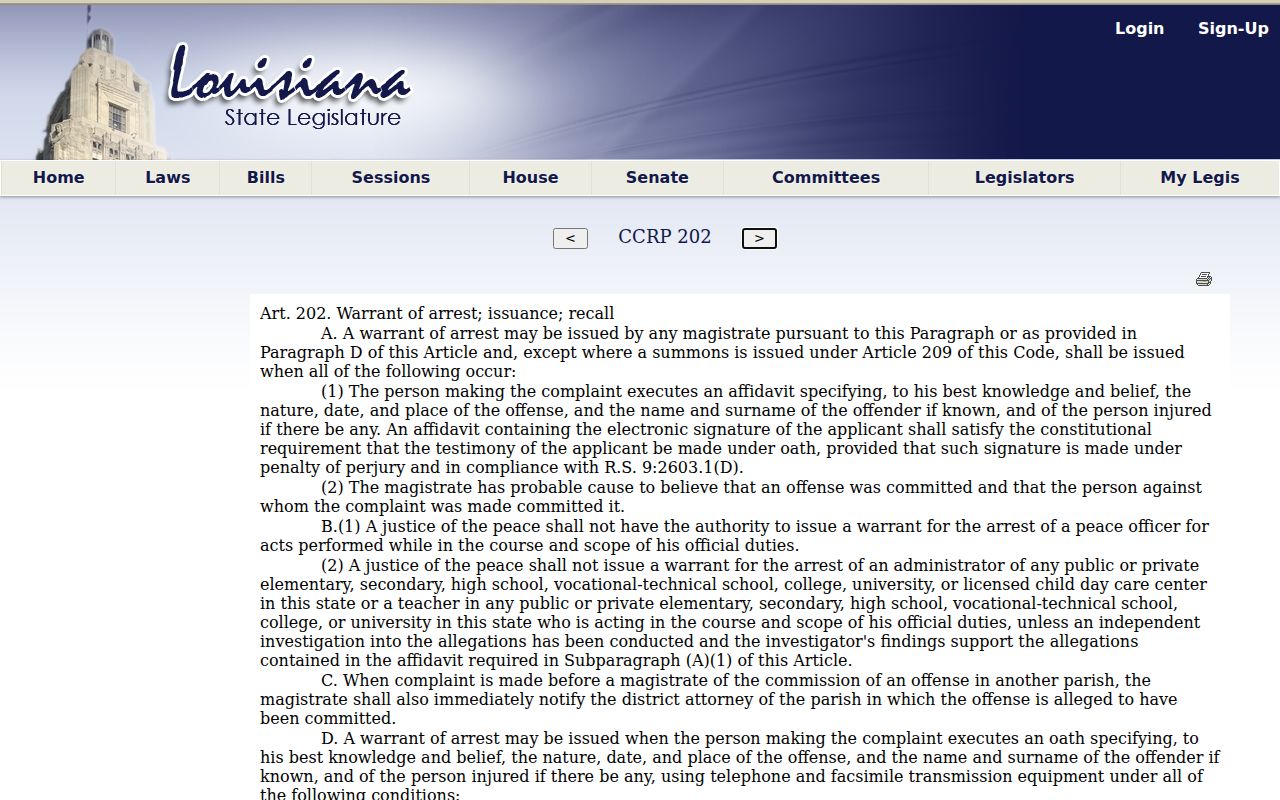
That affidavit step explains why a warrant record reads like a summary of an accusation. Louisiana also allows a gentler path. Under art. 211.1, an officer may hand a person a written summons instead of arresting them on certain misdemeanor and traffic charges in Livingston Parish.
Inside a Livingston Parish Arrest Warrant
A Livingston Parish warrant record carries more than a name. The clerk's file and the serving agency's entry answer different questions. A public view shows less than the court file does, so treat these fields as the questions to ask.
| Warrant or Case Number | The court file identifier, such as a district court docket number. |
|---|---|
| Offense and Statute | The charge named in the affidavit and the section it comes from. |
| Issuing Court and Division | The judge or magistrate who signed it and the division holding the case. |
| Bond or No Bond | A set amount, a direction to appear, or a hold that leaves release to a judge. |
| Service Status | Whether an agency has served the paper and which agency holds it. |
The 21st JDC Felony File in Livingston Parish
The 21st Judicial District Court holds original criminal jurisdiction across Livingston, St. Helena, and Tangipahoa parishes, and its Livingston courthouse sits at 20300 Government Boulevard. Felony charges reach the clerk's criminal department after the district attorney files them, and from that point the docket controls. Ask the criminal filing desk which division holds the case and whether a warrant is attached. A criminal record check costs $20. It returns docket numbers, offenses, and brief dispositions. The district attorney publishes dockets too, but those pages list scheduled hearings rather than active warrants, so a Livingston Parish warrant question still goes to the clerk.
Serving Arrest Warrants in Livingston Parish
Courts issue Livingston Parish arrest warrants, and officers serve them. The sheriff's office runs a warrants and civil command inside its uniform operations division. Its dedicated warrants page lists a unit contact at (225) 435-1330. A separate directory entry lists the same role at (225) 435-1454.
Two numbers appear on official pages, so ask which line is current. A city warrant in Livingston Parish may be served by a city police department or a marshal. Killian's official police page says the town contracts with the sheriff for policing. A serving agency can confirm a service record, but only the issuing court can recall its warrant.
Livingston Parish Arrest Warrant Bond Questions
Bond is set by the court, not the sheriff. It varies with the charge and the case. A Livingston Parish warrant may carry an amount, a direction to appear, or a no-bond order that leaves release to a judge. No parishwide bond schedule is published.
Ask the court: Does the warrant carry a cash amount, a surety condition, a personal-recognizance release, or a no-bond hold, and which office accepts payment?
The clerk's criminal e-filing page sets one deadline that matters. Bond reductions and 701 filings must arrive by noon Wednesday to reach the following week's docket. A bail agent's fee and collateral are contractual, not a government charge.
Comparing Arrest, Summons, and Bench Warrants
Three court instruments can bring a person before a judge, and each starts differently.
| Instrument | How It Starts | What the Person Does |
|---|---|---|
| Arrest warrant | A sworn complaint and a probable-cause finding | Asks the court and the serving agency about bond and surrender |
| Summons | A court or officer commands an appearance | Appears on the date, because a missed date can produce a warrant |
| Bench warrant | A missed appearance or other court noncompliance | Calls the issuing clerk about recall, a new setting, or payment |
A summons is not a warrant. Missing the summons date is what creates the Livingston Parish warrant later. The paper in hand matters more than the words a caller uses.
Federal Warrants and Livingston Parish Cases
Livingston Parish sits inside the U.S. District Court for the Middle District of Louisiana, which sits in Baton Rouge. A federal arrest warrant grows from a federal complaint or an indictment. Federal officers or a task force serve it. The U.S. Marshals district office lists (225) 389-0364 and coordinates the Middle Louisiana Fugitive Task Force. Federal dockets are searchable through PACER for a per-page fee, with a quarterly waiver for low usage, and CourtListener is free. Neither one confirms a warrant, and a sealed indictment may stay unavailable until served. An out-of-state warrant belongs to the state that issued it, so no Livingston Parish list will show it.
If There's an Arrest Warrant for You
A Livingston Parish arrest warrant does not improve with time. A surprise arrest is worse than a planned one.
- Call the issuing court's clerk and confirm the warrant, the charge, and the bond condition.
- Talk to a Louisiana criminal defense attorney about how to resolve it.
- Ask whether the court will take a walk-in appearance, a motion, or a bond, and what it requires first.
- Arrange the surrender with the court and the serving agency instead of appearing unannounced at a jail.
- Keep the receipt, order, or docket entry that shows how the warrant was resolved.
Important: Nothing here is legal advice, and paying a fine does not always end the criminal case behind the warrant.
The county overview shows how those steps fit every warrant type at Livingston Parish warrant records.
Livingston Parish Detention Center Before You Go
The Detention Center sits at 28445 Charlie Watts Road in Livingston. It is where people arrested in Livingston Parish are held. One number reaches the office, jail, and communications: (225) 686-2241. The sheriff lists the address and phone but nothing else practical. No bond-window schedule, accepted payment types, or walk-in surrender hours appear. So call before you drive. Anyone told to report to the jail should confirm the intake process, the bond amount, the ID required, and the hours with the sheriff or the issuing court. A court can recall a warrant while the jail's record still shows a hold. Note: Confirm which agency holds the warrant before traveling, because a city court and the sheriff keep separate records in Livingston Parish.